

India’s Start-up Saga!
The rise of Indian Start-ups and it's implicative ramifications for the National economy.
In the last few years, a new buzzword has stormed its way through Financial Corporatist world’s lexicon, the word being ‘Start-up’. Though the term itself is somewhat vague and not precisely clear, it’s refferingly applied to newly operational business entities that do have a particular momentum behind them, based on the projected demand for their products and services, due to theirs’s ability to offer something new or to better perform an existing task in a Noveller way.
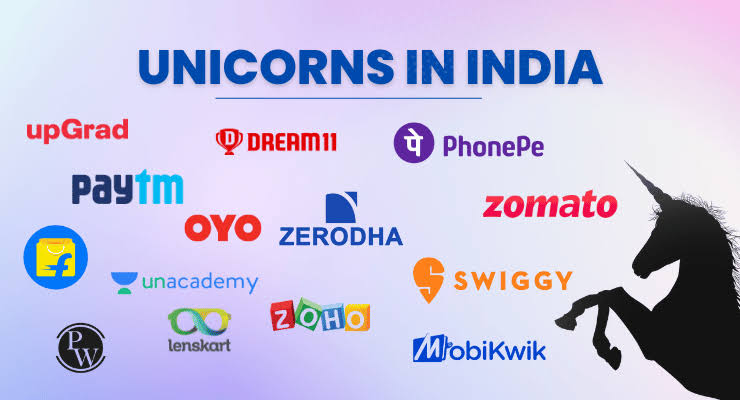
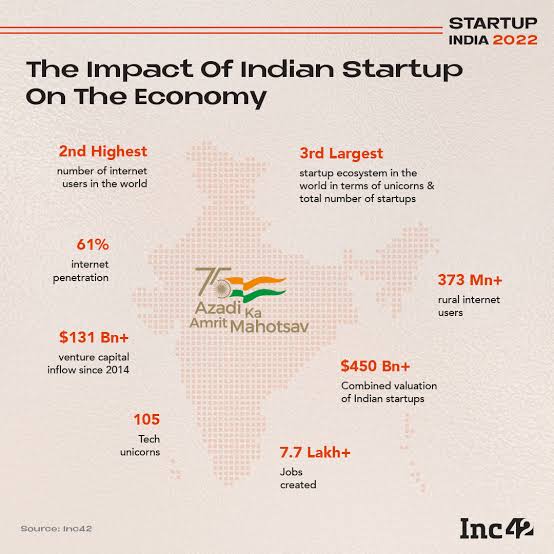
As of October 2023, India currently boasts Asia’s second largest Start-up ecosystem after China and in overall terms the World’s third largest Start-up ecosystem after (US and China), while also hosting the world’s third-largest Unicorn community.
As per the latest statistics, the country has a total of 110 Unicorns, whose combined valuation stands at a whopping $ 347 Billion, with three Indian companies namely – Swiggy, Nykaa and Flipkart having even entered the highly exclusive and quite prestigious Decacorn club as per Dollar valuation metrics. The nation’s trans formative trajectory in regard to all the Start-ups over the last fifteen years has been inspiring to say the least, with the government, financial sector players, innovators and entrepreneurs now intending to adequately sustain what’s been achieved so far.
Yet another splendid achievement of India’s Start-up growth saga has been the largely balanced and well-rounded emergence and subsequent sustainment of a wide array of Start-ups from unconventional sectors such as Data Management & Analytics, Hospitality, E-Gaming etc besides the typical sectors such as Fin-Tech, E-Commerce, Supply Chain & Logistics, Software services etc.
The above – emphasized accomplishment has been realistically been Possiblized in large part, to the enviable quality, as well as the Academic levels of excellence that’re maintained, retained and ceaselessly bettered by the Country’s various storied Higher-Education institutes. A direct result of the hard-work and innovation tried and inputted by these institutes has been the ranking of India (as 2nd in regards to Innovation quality) and the country bagging the 1rd rank in terms of the quality of its scientific publications and the overall quality of its universities, among Middle – Income economies.
The various ways through which Start-ups help the Indian economy are manyfold. Some of those ways are as follows:
- INNOVATION – The foremost and most commonly visible of the various benefits that have been brought about by Start-ups, has been the bringing of fresh and innovative ideas to the market, whose effect has been mostly, (though not completely) for the better.
- SOCIAL CONTRIBUTION-Any place where a Start-up sets up its base of Operations, is likely to experience a drastic boom in commercial growth. The above-mentioned commercial boom, will occur because, there’ll be an entire micro-economy that’ll be set up around a Start-up to supply it with its innumerable requirements.
- WEALTH CREATION – Start-ups do spend a lot of money on hiring talent, beginning and then sustaining their operations, renting commercial spaces among countless other sorts of spending. All the above-mentioned types of spendings significantly boost the local economies of the regions where they’re headquartered. In fact, even failed Start-ups significantly contribute to theirs’s local economies.
- COMPETITION-Till about forty to fifty years back, most of the Industrial sectors were dominated by a few large Industrial conglomerates that were so big, that almost none outside their fold could effectively compete against them. Nowadays, the situation has been completely transformed and democratized, as by-an-large most Industrial sectors are now level-playing
fields, where anyone who’s got quite a farsighted idea and the passion to stringently follow through it, can realistically compete shoulder-to-shoulder against Well-established companies.
- FAILURE SCAR-The risk of failure is very high in fledgling Start-ups as these
newly formed Business-entities need to prove themselves in the Market world and raise Capital before they can start turning a profit. The risk of shutting down or not having enough capital to continue operations before turning a profit is ever-present. - HIGH STRESS-Long hours are characteristics of Start-ups, as everyone is working towards the same goal, that’s to see that the Start-up eventually succeeds. The pursuit of the above-mentioned goals can lead to many high-stress moments and that’s quite harmful to the mental and physical well-being of the workers involved.
- LACK OF SKILLED TALENT-Finding and employing skilled workers is frequently a challenge for Indian Start-ups, as the country’s education system does not provide Start-ups with the necessary skills and training that is urgently required in keeping with the latest International industry standards, hence there’s an acute shortage of skilled professionals in certain fields.
- EXTREMELY HIGH COMPETITION-As there are hundreds of Start-ups competing to hire and keep talented employees, get adequate funding, as well as draw as many customers as possible within the country’s Start-up ecosystem , there’s Cut-throat competition all around. In each and every single one of the different sectors, there’s fierce competition from Fin-tech and E-Commerce all the way to healthcare and education.
- LACK OF MARKET UNDERSTANDING – Most Start-up in the country frequently struggle to identity targeted markets, properly cater to precise customer needs and develop adequate strategies in response to the above-mentioned problems.
Start-ups also do struggle to properly analyse and see to the desired product-market fit, and this inability to properly analyse it leads to subsequent difficulties that they encounter in trying to scale up their businesses.
On a conclusionary note, it must be noted that the rise and growth of Start-ups has impacted the country’s economy in a lot of beneficial ways such as promoting new game-altering ways of doing business, busting formerly-monopolistic Corporate hegemonies and (thereby making certain sectors, broadly level playing fields), fostered and financed the research, development and testing of cutting-edge technologies and systems and directly and indirectly created tons of jobs (of all types) for the country’s youths.

Nevertheless, our country’s institutions, companies and enterprise-minded individuals must not rest on their laurels, as our country has a very long road ahead (demanding loads of intense\ceaseless effort that’s required for future accomplishments of a much bigger, greater level) yet to cover as well as several serious lacking, deficiencies to eradicate in the immediate few years to come.
The objectives that should now be given priority focus, are the simplification of administrative procedures in regards to the (registering, taxing, permitting, licensing and renewing of) of Start-up entities, a significant increase in funding for Higher Education Institutes and research centers, granting of generous financial and welfare benefits to skilled and talented employees by Big companies in order to possibly retain them in India (in a bid to limit Brain drain), further improve the state of physical infrastructure throughout the length and breadth of the country to name a few, amongst many other similar areas and issues, urgently needing an improvement-delivering focus.
𝚅𝚎𝚛𝚢 𝚠𝚎𝚕𝚕 𝚠𝚛𝚒𝚝𝚝𝚎𝚗 .
Brilliant Work!
Amazing read, very comprehensive, great work!
I must say that the article reflects a detailed understanding of the subject and also capacity to beautifully summarize the article around deserving cardinals. Please keep honing your great skills by covering other topics and keeping us informed citizenry.
Its quite a good article written with a proper research and continuity. Would like to appreciate your efforts for putting your thoughts with clarity.